Land Leveling and Increasing the Sustainability of Agricultural Products
Agricultural production is one of the most important economic industries in the world, providing food for society and generating foreign currency for countries. However, agricultural production in many regions faces problems such as water scarcity, unsuitable soil, and unfavorable climatic conditions. To address these issues, improving and increasing the sustainability of agricultural products is essential. One effective solution for enhancing the sustainability of agricultural products is land leveling. In general, land leveling involves actions carried out on the land surface to make it smooth and uniform in terms of slope and elevation. This practice reduces or eliminates slope variations and increases the usable land area. Smooth and level fields offer many advantages for agricultural production.
However, land leveling is not merely a simple or superficial operation. Leveling the land is considered a crucial factor in the stability and sustainability of farmland and its crops. Below, we examine the vital role of land leveling and its profound impact on increasing the sustainability of agricultural products:
The Impact of Land Leveling on the Sustainability of Agricultural Products
The effect of land leveling on water management, crop yield, soil conservation, and economic resilience is profound.
### Increased Production Capacity
Uniform crop growth is a sign of precise land leveling. Accurate leveling of agricultural land ensures that all crops have equal opportunities to grow. In addition to increasing crop yield, land leveling provides the conditions for implementing precision farming techniques and optimizing resource use. Furthermore, land leveling increases the cultivated area and reduces slope variations, leading to greater agricultural production capacity. This reduces the need to destroy natural resources such as forests and orchards. Additionally, by eliminating slope variations, the risk of soil slippage and erosion decreases, which enhances the sustainability of agricultural products.
### Improved Irrigation Performance
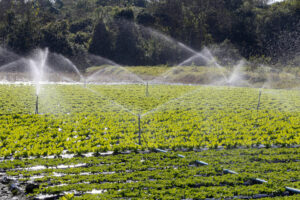
Effective water management plays a very important role in agricultural productivity. Land leveling improves irrigation performance by increasing the soil’s ability to absorb water. This practice also reduces evaporation and transpiration from the soil surface and increases moisture retention in the soil, contributing to more efficient irrigation and protection of water resources. Therefore, by improving and optimizing water management, all agricultural crops benefit from adequate water, and water waste is greatly reduced. This, in turn, leads to greater sustainability and growth of agricultural products.
### Environmental Protection
Land leveling helps protect the environment. For example, soil conservation is essential for long-term sustainable agriculture. Land leveling, by preserving the integrity of the topsoil and reducing slope variations, decreases the risk of soil slippage and erosion. As a result, this protects the nutrients needed by agricultural crops and increases the productivity and sustainability of agricultural output.
Moreover, by improving irrigation performance and reducing water consumption, water resources are conserved, and by increasing production capacity, the need to destroy natural resources is reduced. Consequently, land leveling can be used as an effective strategy for environmental protection and increasing the sustainability of agricultural products.
Cost Reduction
Investment in land leveling can generate significant economic returns for farmers. By increasing the land area and reducing slope variations, land leveling lowers production costs, boosts the capacity for agricultural production, and reduces expenses associated with natural resource degradation. By eliminating slope variations, costs related to repairing damage from soil slippage and erosion are reduced. Furthermore, with improved irrigation performance, costs related to water consumption and labor also decrease. Therefore, agricultural land leveling enhances both the sustainability of crops and the economic returns for farmers.
### Improved Product Quality
Land leveling improves the quality of agricultural products. By increasing production capacity and improving irrigation performance, higher-quality crops with greater added value are produced. Additionally, by reducing production costs and protecting natural resources, agricultural products are grown with minimal use of pesticides and chemicals, which improves consumer health and increases the sustainability of agricultural products.
### Understanding Topographic Changes
Land leveling is not merely about smoothing and leveling uneven farmland. Agricultural land leveling involves a precise assessment of topographic changes. Topography determines water flow, drainage, and soil quality. All of these are critical factors in increasing the sustainability of agricultural products.
Final Word
Leveling agricultural lands increases the sustainability of agricultural products. By increasing production capacity, improving irrigation performance, reducing production costs, and protecting the environment, land leveling can be used as an effective strategy for enhancing the sustainability of agricultural output. This approach leads to greater production capacity, better irrigation performance, lower production costs, improved product quality, and environmental protection. In general, land leveling can be employed as an effective solution for increasing the sustainability of agricultural products in many regions of the world.