## Tackling Water Scarcity in the Agricultural Industry
About 70 percent of global water consumption is used by the agricultural industry and the food production industry. As the world’s climate becomes increasingly unstable and the population continues to grow, excessive water consumption will have irreparable effects on food production around the world. For this reason, scientists and researchers around the globe are working to develop smart solutions to address water scarcity.
—
## Solutions for Dealing with Water Shortage
In this article, we describe several modern methods that researchers have proposed for tackling water scarcity in the agricultural industry.
### Irrigation Systems with New and Modern Technology
Digitizing agricultural systems is one of the new technologies that helps tackle water scarcity. Some companies provide farmers with technologies that, thanks to soil-moisture sensors, reduce water consumption by up to 30 percent. The Italian company Bluetentacles is one such company, helping farmers irrigate their fields only when necessary. A similar system has also been developed by the Spanish startup BioAgro, which has created a smart irrigation platform using low-cost technology based on data obtained from sensors. The sensors calibrate soil moisture and automatically perform irrigation and fertilization only when the crops need it.
### Drip Irrigation Systems
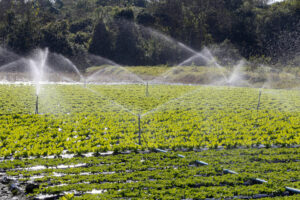
Drip irrigation, which has been used in Iran for some time, is another desirable way to tackle water scarcity in the agricultural industry, especially in hot and dry regions. This technology, by placing pipes underground and opening tiny holes in the pipes near the plant roots, ensures that water is not lost to evaporation. The pipes are then opened repeatedly at short intervals to supply the water the plants need. Studies show that drip irrigation systems have been used successfully in arid and semi-arid regions to produce vegetables and forage crops, maintain trees, and more.
### Water Storage in Arid Regions
In arid regions, storing water intelligently is very important for tackling water scarcity. In Colombia, the CGIAR Research Program on Climate Change, Agriculture and Food Security (CCAFS) focuses on Climate-Smart Agriculture (CSA) to help small-scale farmers adapt to climate change and mitigate its effects. This is achieved by collecting rainwater when it is available and helping farmers effectively channel rainwater into storage reservoirs for use during periods of water shortage.
### Treatment and Reuse of Wastewater
To manage wastewater better, the Italian company Captive Systems removes pollutants from wastewater using magnetic nanoparticles with a ferromagnetic core and an external coating. This system is able to completely remove various types of pollutants from effluents—from hydrocarbons and organic compounds to metals. In this way, waste and dirty water can be recycled for reuse, with the aim of tackling water scarcity in agriculture.
### Aquaponics
Aquaponics offers an attractive solution for tackling water scarcity in agriculture. This system results from combining fish farming with hydroponics (growing plants in water, without soil). On some farms, these systems can reduce water consumption by up to 90 percent compared with traditional agriculture.
### Satellite Land Leveling
Today, using satellites and GPS technology, very precise information can be obtained about your farmland. This information can include soil type, land size, climate changes, crop status, and more. This technology is a branch of Precision Agriculture, whose goal is to help farmers improve the quality and efficiency of their crops and their activities in the field. Using data obtained through satellites, you can level your land in the best possible way with the least error. As a result of land leveling, crop quality increases, and water consumption is carried out more precisely and in a more balanced way. For this reason, satellite land leveling technology is considered one of the good methods for tackling water scarcity in agriculture.
—
## Conclusion
Overall, we should all think about water consumption in our lives. It is true that most of the world’s water is used by farmers, food production industries, and factories, but we too must think about conserving water. We all know that water is the source of life, and unfortunately, according to forecasts, in the not-too-distant future we may face very serious problems with water. By using the methods mentioned, we can tackle water scarcity and even improve our country’s agricultural industry.